In a perfect world, a "Valid" response from the VIES system would be enough. In the real world of EU tax audits, if you can't produce the proof three or seven years later, that "Valid" status might as well not exist. Under Article 138 of the EU VAT Directive (2006/112/EC) and national tax codes (such as § 6a UStG in Germany), the burden of proof rests entirely on the supplier. When national tax inspectors (from the German Finanzamt, Dutch Belastingdienst, Polish Urząd Skarbowy, French DGFiP, Spanish AEAT, or Italian Agenzia delle Entrate) inspect your transactions, unverified screenshots or a simple database flag are legally rejected, exposing you to retroactive VAT assessments and interest penalties.
1 The "Must-Have" List: What to Keep
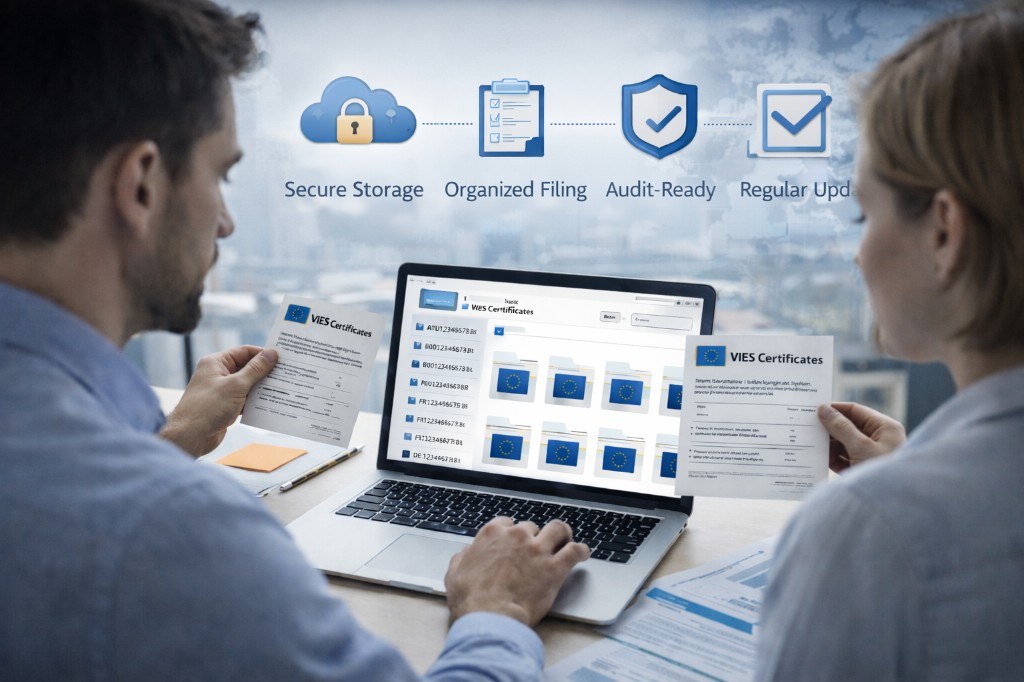
To protect your business from VAT liability and fines, every cross-border B2B transaction should be linked to a specific validation record. Don't just store a "Yes/No" flag; store the raw data.
| Data Point | Why It Matters |
|---|---|
| VAT Number | The primary key for the transaction. |
| Timestamp | Proves you checked the status at the time of sale. |
| Validation Result | The official "Valid" or "Invalid" status. |
| Consultation Number | The unique ID provided by VIES for the specific check. |
| Technical Response | The raw XML/JSON data (for deep technical audits). |
| PDF Certificate | A human-readable proof for quick manual inspections. |
2 The 8-to-10-Year Retention Rule: OSS & GoBD (BEG IV)
Under Article 63c of Council Implementing Regulation (EU) No 282/2011, businesses using the One-Stop Shop (OSS) must keep records for 10 years. For standard intra-community B2B trade, national tax laws mandate 6–10 years of immutable archiving—in Germany, for example, tax and GoBD accounting retention periods were lowered from 10 to 8 years under § 147 AO / Viertes Bürokratieentlastungsgesetz (BEG IV) effective 1 January 2025. To keep every Member State audit covered, VIESAC archives every record for 10+ years and seals each certificate with a SHA-256 integrity hash plus an eIDAS-qualified RFC 3161 timestamp from DigiCert EU (independently verifiable at viesac.eu/verify).

Pro Tip
Storage must be durable and tamper-proof. A screenshot on a local laptop that might crash next month is not a compliance strategy. Use a secure, EU-hosted vault (Nuremberg, Germany) that retains official consultation numbers and RFC 3161 verifiable PDF certificates.
3 Best Practices for Data Residency & GDPR
Since VAT numbers can be linked to sole traders or small partnerships, they often fall under GDPR protection.

Keep your tax data on servers within the EU (Nuremberg, Germany) to satisfy strict tax and GDPR residency requirements.

Data is encrypted at rest and in transit, with SHA-256 hashing and DigiCert EU RFC 3161 timestamping.

Export or verify VAT (53 live jurisdictions / 116 countries), EORI, REX, SEED, and SME certificates by tax ID, date, or order reference anytime.
4 Frequently Asked Questions: Storing VIES Certificates
How long do businesses have to keep VIES validation certificates?
Most EU Member States require 6 to 10 years of retention. EU OSS records require 10 years under Article 63c of Regulation 282/2011, while Germany lowered commercial/tax invoice retention to 8 years under GoBD and BEG IV. VIESAC stores audit evidence for 10+ years.
Why is a DigiCert EU RFC 3161 timestamp stronger than a local screenshot?
Screenshots can be edited or disputed. Each VIESAC PDF certificate combines the official response with SHA-256 integrity hashing and an eIDAS-qualified RFC 3161 timestamp from DigiCert EU, verifiable publicly at viesac.eu/verify.
Where does VIESAC store validation certificates under GDPR?
Validation records and PDF/XML evidence are hosted on GDPR-compliant infrastructure in Nuremberg, Germany (EU), keeping tax and personal trader data within the European Union.
What fields should every stored VAT audit record contain?
Retain the VAT ID checked, timestamp, exact Valid/Invalid status, VIES consultation number or national registry ID, matched company name/address, raw XML/JSON payload, PDF certificate, and invoice or order reference.
Can VIESAC archive non-EU VAT and customs checks in the same vault?
Yes. Alongside EU VIES, VIESAC archives national registry VAT checks across 53 live jurisdictions (116 covered countries) plus EU/UK EORI, REX, SEED, and SME validations.

How VIESAC Automates Your Audit Trail
Managing a decade of PDF certificates manually is impossible for a growing business. VIESAC does the heavy lifting for you:
- →Automatic PDF Generation: Every validation triggers the creation of a downloadable, time-stamped certificate.
- →10+ Years of Retention: We store your audit trail securely for the long haul, meeting the highest EU standards.
- →Developer-First API: Link your validations directly to your order IDs via our API for a seamless "Order → Validation → Invoice" connection.
- →WooCommerce Ready: Our plugin automatically stores the validation proof right inside your WordPress dashboard for every checkout.
Stop worrying about "what if" — Build a "here it is" archive
Pro Tip
EU VAT record keeping requirements: 10 years for OSS, 8 years in Germany under GoBD/BEG IV, and 6–10 years across EU Member States. Use a system that stores the consultation number, technical XML/JSON response, and an RFC 3161 certificate verifiable at viesac.eu/verify. VIESAC keeps everything in Nuremberg, Germany (GDPR-ready) across API, Shopify, WooCommerce, SAP, Microsoft, Google Sheets, Make, and AI MCP. See also what to do when VIES is unavailable.