The landscape of European taxation is undergoing its most significant transformation in decades. If your business operates within the EU, you’ve likely heard the acronym ViDA (VAT in the Digital Age)—formally adopted on 11 March 2025. Between national B2B e-invoicing mandates rolling out from 2026 onward and mandatory EU-wide Digital Reporting Requirements taking effect on 1 July 2030, the room for manual VAT errors is shrinking to zero.
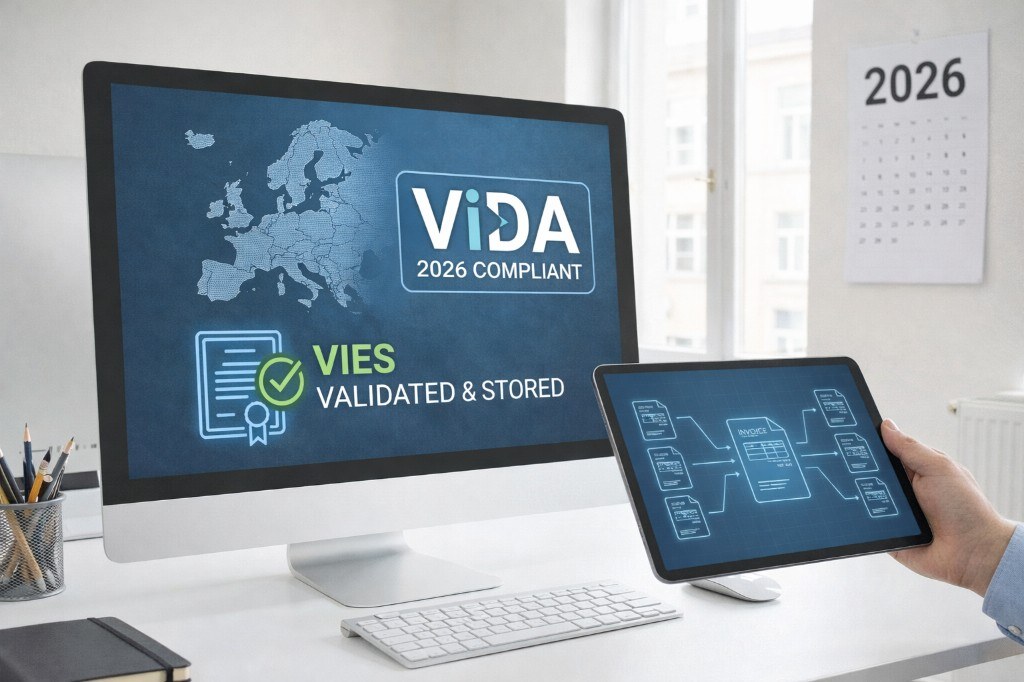
From mandatory e-invoicing to near real-time reporting, doing business with ad-hoc screenshots won’t hold up under modern audits. Here is how you can stay ahead of the curve.
1 Understanding the ViDA Pillar: What’s Changing?
ViDA is built on three main pillars, but for most businesses, the Digital Reporting Requirements (DRR) and Mandatory E-invoicing are the immediate priorities.

Gone are the days of monthly or quarterly summaries. ViDA aims for "near real-time" digital reporting for intra-community transactions.

For B2B cross-border transactions, electronic invoices will become the default standard.

VAT number validation via VIES is shifting from a "best practice" to a core requirement of your audit trail.
2 The Shift from Optional to Essential
In the pre-ViDA era, checking a VAT number was often a box-ticking exercise. Under the new rules, VAT validation must be performed at the point of sale and documented meticulously.
If you can’t prove that your partner’s VAT number was valid at the exact moment of the transaction, you risk heavy fines and the loss of VAT-exempt status. An audit trail isn’t just a list—it’s your insurance policy.
3 Practical Steps to Readiness
With national e-invoicing mandates expanding from 2026 onward ahead of EU-wide DRR on 1 July 2030, you should audit your tech stack today:
- Automate Your VIES & National Checks: Manual checks fail at scale and break during VIES downtime. Use VIESAC’s REST API, SmartRouter™ (25+ national registry fallbacks across 53 live jurisdictions / 116 countries), WooCommerce, Shopify, SAP, Microsoft, Google Sheets, Make, or AI MCP.
- Store Cryptographic Certificates: Storing a simple "valid" boolean is not enough; retain PDF certificates & XML/JSON evidence sealed with SHA-256 and an eIDAS-qualified RFC 3161 DigiCert EU timestamp (viesac.eu/verify). Read how to store VIES certificates for compliance.
- Validate Multiple Trade IDs: Ensure onboarding and invoicing workflows can verify VAT plus EU/UK EORI, REX, SEED, and SME identifiers consistently.
4 Frequently Asked Questions: ViDA Readiness
When do ViDA Digital Reporting Requirements (DRR) become mandatory across the EU?
The ViDA package was adopted by the EU Council on 11 March 2025. While individual Member States roll out domestic B2B e-invoicing from 2026 onward, mandatory EU-wide structured e-invoicing and near real-time DRR for intra-community B2B supplies apply from 1 July 2030.
Why is VIES VAT validation non-negotiable for ViDA?
Real-time DRR matches buyer and supplier invoice data automatically. Issuing a zero-rated EN 16931 e-invoice without an active, documented VAT ID triggers instant mismatches and risks losing your Article 138 VAT exemption.
How does VIESAC prove validation checks years later during a tax audit?
Each validation generates a downloadable PDF certificate and raw XML/JSON log sealed with SHA-256 hashing and an eIDAS-qualified RFC 3161 timestamp from DigiCert EU, independently verifiable anytime at viesac.eu/verify.
What if VIES is unavailable or we trade outside EU VIES?
VIESAC’s SmartRouter™ routes eligible checks through 25+ national tax registry fallbacks across 53 live jurisdictions (and 116 covered countries), integrating with Bulk Audit CSV/XLSX, WooCommerce, Shopify, SAP, Microsoft, Google Sheets, Make, and AI MCP.

Why VIESAC is Your Secret Weapon for ViDA
Transitioning to ViDA compliance doesn’t have to be a headache. VIESAC was built specifically to bridge the gap between old-school accounting and the digital future.
- →Automated Validation: Seamlessly integrate VAT checks via our REST API or WooCommerce plugin.
- →Audit-Ready Storage: We store the official certificates so you’re always prepared for a tax inspector’s visit.
- →Developer Friendly: Our API is designed for rapid deployment with WooCommerce or custom ERP.

Pro Tip
Start building your RFC 3161 cryptographic audit trail now across VIES and national registries so your finance stack is ready well before national mandates and EU DRR take full effect.