Why do standard VAT validators fail when your business needs them most? Across European and international B2B commerce, high-value orders stall at checkout, ERP invoice runs pause in exception queues, and finance teams face avoidable tax exposure—not because the customer’s VAT number is invalid, but because a single government gateway went offline, hit a concurrency cap, or does not cover the counterparty’s country.
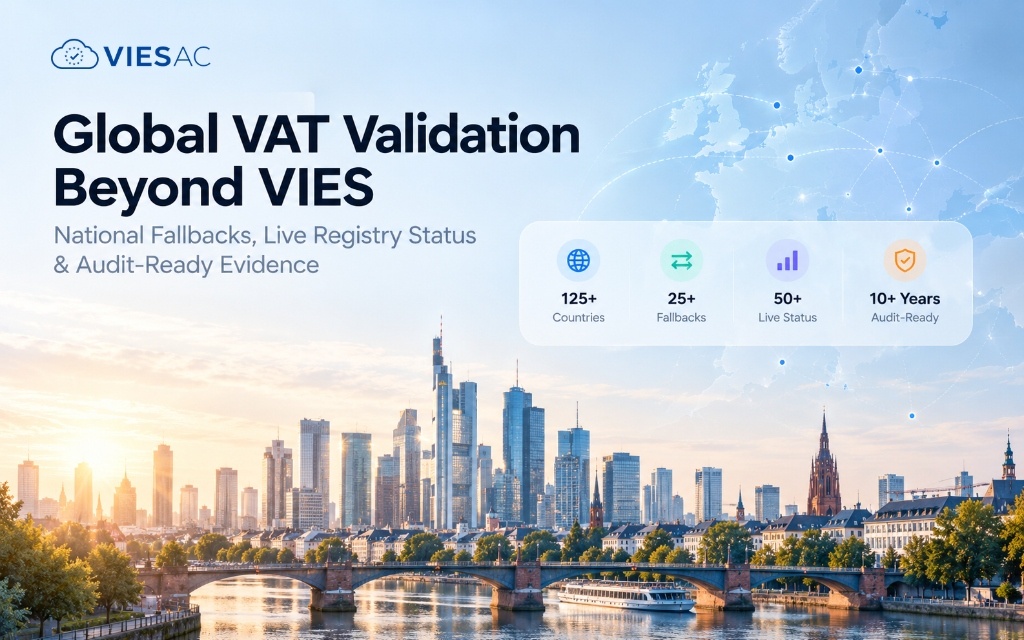
Most VAT validation plugins and legacy integrations are built as single-channel pass-through scripts connected only to the European Commission’s VIES interface. When a national tax node in Germany, Italy, France, or Spain enters maintenance—or when your procurement team onboards a supplier from the United Kingdom, Switzerland, Norway, Turkey, Australia, or the UAE—a single-source checker simply fails.
In this guide, we examine the operational and fiscal risks of single-source tax verification, how national fallback channels and direct non-VIES registry connections eliminate single points of failure, and how the VIESAC Countries & Service Status Hub brings live registry visibility and audit-grade evidence into one workflow.
Executive Summary: 3 Structural Failures of Single-Source VAT Checkers
Why finance, tax, e-commerce, and engineering teams are replacing single-endpoint VIES scripts with multi-layered verification.
EU VIES is not a centralized database; it relays requests in real time to individual national tax servers. When a member-state node experiences downtime or throttling (MS_UNAVAILABLE, TIMEOUT, MS_MAX_CONCURRENT_REQ), single-channel tools either block legitimate B2B buyers or pass unverified zero-rated invoices.
Modern supply chains and digital services cross borders daily. Standard VIES checkers reject valid tax identifiers from the UK (HMRC), Switzerland (UID), Norway (Brønnøysund), Turkey (GİB), Serbia (PURS), Australia (ABR), the UAE (FTA), India (GSTN), Singapore (ACRA), and Japan (NTA), forcing staff into manual portal checks.
Even when a primary registry responds, several jurisdictions return a bare VALID status without the company’s legal name or address—or teams rely on browser screenshots that tax auditors reject during retrospective inspections.
1The Hidden Cost of Single-Source VAT Validation
Under Article 138 of the EU VAT Directive (2006/112/EC) and equivalent international zero-rating and reverse-charge rules, exempting a cross-border B2B supply from domestic VAT requires proving that the buyer held an active tax registration at the time of supply.
Public government tax portals, however, were never designed to operate as ultra-low-latency global commerce infrastructure. Each national authority manages its own maintenance windows, rate limits, and data disclosure policies. Relying on a basic single-channel checker turns every external server hiccup into an internal business problem:

When a national node goes offline during business hours, merchants face a painful trade-off: block the B2B customer at checkout and lose the sale, or grant a 0% VAT exemption blindly and risk paying 19% to 27% VAT out of pocket plus interest during a tax audit.

Accounting and AP teams working with non-EU partners must navigate dozens of foreign-language government portals, solve CAPTCHAs, and manually copy tax identifiers into ERP vendor records.

When a registry confirms validity without returning corporate identity details, or when formatting typos slip into master data, finance teams waste hours resolving exceptions before filing deadlines.
In a formal tax inspection, "the government portal was temporarily unreachable" is not a defense on its own. Tax authorities expect documented commercial due diligence, verification continuity, and a verifiable record of how and when each counterparty was checked.
2National Fallbacks & Multi-Layer Verification: Eliminating Single Points of Failure
Instead of treating VAT validation as a simple pass/fail ping to a single URL, VIESAC is built as a multi-layered verification and evidence system. On the VIESAC Country Coverage & Service Status page, European coverage is reinforced by multiple independent layers of continuity:
- →25+ National Fallback Paths Across Europe: When VIES cannot complete a check due to a national node outage or timeout, VIESAC routes verification through additional national fallback paths. Depending on the jurisdiction, coverage operates as Full National Coverage (providing a broad national fallback verification path when VIES is disrupted) or Partial National Coverage (supporting selected identifier variants, cases, and corroborating evidence). Live per-country fallback tiers and filterable status indicators are unlocked on
/countriesfor Pro and higher plans. - →5 Shared Cross-Country Verification Layers: Complementing country-specific fallbacks, VIESAC coordinates five shared verification and evidence layers—combining alternative official channels, verification history, evidence discovery, and multi-stage automated evidence review.
- →Stored Registry Snapshots with Explicit Provenance: Where supported, VIESAC maintains periodically refreshed verification datasets with transparent snapshot dates (visible on Pro and above). When an upstream live endpoint stalls, the system preserves continuity while clearly recording in the audit trail whether a finding came from a live primary registry, a national fallback, or a dated snapshot.

Real-World Pain Point: What Happens When Germany (DE) VIES Is Down (MS_UNAVAILABLE)?
For companies trading in Europe, Germany (DE) is often the single most painful jurisdiction for automated VAT checks. German VAT numbers (USt-IdNr.) represent the highest cross-border B2B volume in the EU, yet the German VIES node frequently returns MS_UNAVAILABLE or concurrency faults during maintenance windows and peak business hours. Moreover, due to strict German privacy rules, standard EU VIES responses for German numbers do not return the company’s name or address.
How VIESAC solves the German bottleneck: When the central EU VIES gateway fails to reach the German node—or returns a blank profile—VIESAC does not block your checkout or stall your ERP batch. Instead, our routing engine automatically switches to a direct verification channel with the German Federal Central Tax Office (BZSt — Bundeszentralamt für Steuern) alongside corroborating national verification layers, while queuing the official VIES check in the background. Your workflow receives an immediate, well-supported result with clear provenance.
Quick Access: Popular EU VAT Validators & Live Country Coverage
| Operational Dimension | Basic VIES API Wrapper | Manual Portal Lookups | VIESAC Multi-Layer Ecosystem |
|---|---|---|---|
| Primary Gateway Outage (e.g. MS_UNAVAILABLE) | Hard failure; checkout or ERP job breaks immediately | Staff must manually recheck portals hours or days later | Routes through national fallbacks (e.g. BZSt in DE), shared layers & queued recovery |
| Geographic Reach | EU VIES only (rejects UK, CH, NO, TR, AU, AE, etc.) | 20+ separate national websites in local languages | 50+ live validation jurisdictions + VAT/GST rates across 116 countries |
| Missing Company Name / Address | Returns empty fields; forces manual KYB review | Manual cross-referencing across trade registers | VIESAC AI researches & verifies missing corporate details with recorded provenance |
| Pre-Call Error Prevention | Sends malformed strings directly to government servers | High human typo rate across unfamiliar formats | Instant format & mathematical check-digit validation before network calls |
| Audit Defense & Evidence | Ephemeral JSON boolean (no long-term proof) | Unauthenticated browser screenshots (rejected in audits) | SHA-256 sealed PDF certificates + raw XML evidence archived long-term |
Crucially, VIESAC never blurs the line between a provisional fallback finding and an official primary confirmation. Every API response and audit record documents the exact verification origin, timestamp, and status.
3Beyond the EU Border: 50+ Validation Jurisdictions & 116 Total Countries
Cross-border trade does not stop at the borders of the European Union. Maintaining separate tax connectors for every non-EU country is complex and expensive. VIESAC unifies 116 countries and territories into a single operational standard, with 50+ jurisdictions supporting live VAT/GST registration validation and audit creation:
| Coverage Tier | Scale | Covered Countries & Territories | What VIESAC Delivers |
|---|---|---|---|
| 01 / European VIES Coverage | EU-27 + XI & MC | All EU Member States plus Northern Ireland (XI) and Monaco (MC) | Live VIES validation, national fallback paths, shared verification layers & audit certificates |
| 02 / Beyond VIES (Europe & Eurasia) | National Registers | United Kingdom (GB), Switzerland (CH), Norway (NO), Turkey (TR), Serbia (RS), Iceland (IS), Bosnia & Herzegovina (BA), Albania (AL), North Macedonia (MK), Armenia (AM), Georgia (GE) | Direct live validation against official national tax registers + audit certificates |
| 02 / Beyond VIES (APAC, MEA & Americas) | Global Registers | Australia (AU), United Arab Emirates (AE), India (IN), Singapore (SG), Japan (JP), Taiwan (TW), South Africa (ZA), Egypt (EG), Argentina (AR) — and continuously expanding | Live VAT/GST/Tax ID validation (ABR, FTA, GSTN, ACRA, NTA, FIA, SARS, ETA, ARCA) + audit certificates |
| 03 / Extended Global Rate Coverage | 116 Total | All validation jurisdictions plus extended VAT/GST rate lookup across 116 global economies | Verified standard, reduced & special national VAT/GST rates via the Rate Finder & API |
Every supported validation jurisdiction—across both EU VIES and 20+ non-VIES national tax registers—works through the same VIESAC REST API, Bulk Audit tool, and storefront extensions, removing the need to build separate integrations for HMRC, the Swiss UID Register, Norway’s Brønnøysund Register, GİB, PURS, ABR, or the UAE FTA.
Direct Links: Non-VIES National Tax & VAT/GST Validators
4How SmartRouter™ & SmartCache™ Keep Checks Moving During Outages
How does VIESAC maintain fast, reliable responses when upstream government portals slow down or reject connections? Our verification pipeline coordinates four stages:
Before making any external network call, VIESAC normalizes input formatting and checks country-specific structural rules and statutory mathematical check-digit algorithms. Typos and invalid check digits are rejected instantly.
SmartRouter™ evaluates live service telemetry for the target country, coordinating official primary checks, national fallback paths, cross-country verification layers, and stored registry snapshots according to strict verification rules.
When ERP batches or checkout spikes query the same counterparty repeatedly, SmartCache™ reuses eligible recent results—reducing latency and protecting government endpoints from rate-limit blocks (IP_BLOCKED / GLOBAL_MAX_CONCURRENT_REQ).
When an official source stalls (MS_UNAVAILABLE or TIMEOUT), VIESAC preserves available fallback evidence with its origin and timestamps, distinguishes provisional findings from official confirmation, and queues eligible audits for background rechecking.
Read our detailed guide on handling VIES unavailability and SOAP fault codes for a closer look at outage recovery.
5Resolving Missing Company Details with VIESAC AI Enrichment
Even when a tax registry is online, compliance teams often hit a second roadblock: the registry confirms that the tax number is valid, but omits the legal company name or registered address (as seen with standard German VIES queries or certain non-EU portals). For B2B invoicing, Know Your Business (KYB) onboarding, and ERP master data hygiene, a bare "valid" boolean is rarely enough.
On plans that include advanced enrichment, VIESAC AI agents research missing corporate details using large language models (LLMs), purpose-built compliance prompts, internal verification history, and information retrieved from official and public sources.

Strict Audit Separation: Provenance Over Guesswork
VIESAC AI uses identifier matching and source checks to assess whether a finding belongs to the company being checked, and records its provenance in the audit trail so enriched details remain clearly distinguishable from the original registry response. AI enrichment never independently establishes current VAT registration.
This gives accounting and procurement teams complete company profiles for their records while keeping the statutory audit trail faithful to the underlying government registry response.
6Live Registry Status Transparency (/countries)
Most API providers hide upstream registry outages behind generic error codes, leaving developers and accountants guessing whether the issue lies in their integration or a national tax office abroad. The VIESAC Countries & Service Status Hub (/countries) provides real-time operational clarity:
- →Live VIES & Beyond-VIES Health Monitors: Check at a glance whether European VIES routes and non-VIES national registers are reporting available, restricted, or disrupted.
- →Freshness Expiration: Status indicators use periodically saved diagnostic snapshots and automatically stop displaying an "available" state if a snapshot becomes older than its freshness window.
- →Pro Fallback & Snapshot Telemetry: Users on Pro and higher plans unlock per-country National Fallback availability, interactive Full/Partial/Other coverage filters, and stored registry snapshot dates.
- →Format & Checksum Reference: Every supported country displays its local tax system acronym (VAT, MwSt, TVA, IVA, BTW, USt, MVA, KDV, PDV, GST, JCT), accepted number structure, and mathematical check-digit status.
Before opening a support ticket or pausing an international billing run, your team can check viesac.eu/countries in seconds to verify live registry standing.
7Preparing for ViDA (2030 DRR), Vertrauensschutz & Long-Term Audit Retention
Multi-country verification and fallback resilience directly support three core pillars of modern tax governance:
- →Preparing Ahead of the ViDA Rollout (1 July 2030 Cross-Border DRR): While several EU Member States are introducing domestic e-invoicing mandates over the coming years, the core EU-wide cross-border B2B Digital Reporting Requirements (DRR) and mandatory EU e-invoicing under ViDA (VAT in the Digital Age) take effect on 1 July 2030. Cleaning ERP master data and automating point-of-sale VAT validation now prevents costly ERP migrations and invoice rejections as national and EU milestones arrive.
- →Proving Commercial Good Faith (Vertrauensschutz): Under European tax jurisprudence and national laws (such as § 6a UStG in Germany), defending zero-rated supplies when a primary server is down requires proving that you exercised commercial diligence at the time of transaction, preserved available fallback evidence, and obtained official confirmation once the registry recovered.
- →Tamper-Evident Archiving with a 10-Year Safety Buffer: Statutory invoice and tax record retention periods vary by country and regime—for example, Germany’s standard statutory retention period for invoices (Buchungsbelege / Rechnungen) is currently 8 years, whereas special EU schemes like the One-Stop Shop (OSS, Article 63c) require 10 years. VIESAC retains SHA-256 sealed PDF certificates and raw XML evidence in an EU-hosted archive for 10+ years as an enterprise safety margin that comfortably covers both 8-year national rules and 10-year cross-border regimes.
Whether a tax inspector reviews an intra-EU supply, a UK shipment with Hybrid VAT + EORI verification, or a cross-border B2B invoice to Zurich, Istanbul, Belgrade, or Sydney, your evidence is structured and linked to your invoice number.
8Integrations: Connect Accounting, ERP, E-Commerce, Make & AI (MCP)
Every validation route and rate lookup on the Countries page can be embedded directly into your existing finance, commerce, and automation stack:
Automate counterparty VAT/GST checks and certificate attachment across Intuit QuickBooks (Online & Enterprise), Xero, Sage (Intacct, 50/200), Zoho Books, FreshBooks, DATEV, Exact Online, Lexoffice, sevDesk, Pennylane, Holded, Fortnox, and Visma via our API and Make integration.
Unified REST endpoints and integration guides for SAP S/4HANA & ECC, Microsoft Dynamics 365 (Business Central & Finance), Oracle NetSuite, Oracle Cloud ERP, Odoo, Salesforce, HubSpot, and Workday—plus CSV Bulk Audit for master-data scrubbing.
Validate B2B checkouts in real time with our native WooCommerce extension and Shopify app, or connect Magento (Adobe Commerce), Shopware, BigCommerce, PrestaShop, Stripe Billing / Tax, Chargebee, and Recurly.
Use our official Make.com app, Google Sheets add-on, and webhook/REST connectors for Zapier, n8n, and Microsoft Power Automate to connect VIESAC to 1,500+ business apps without writing code.
Building autonomous finance, KYB onboarding, or procurement AI agents? VIESAC supports modern MCP (Model Context Protocol) and machine-readable discovery—allowing AI assistants (such as Claude, ChatGPT, Cursor, and enterprise LLM copilots) to invoke live VAT/EORI validations, check fallback status, and retrieve compliance proof directly inside agentic workflows.
Need a custom integration? Explore our integration hub below, connect your cloud tools via Make or the REST API, or contact our team to discuss bespoke connectors for your accounting or ERP environment.
9Frequently Asked Questions: Global VAT Coverage, Fallbacks & Compliance
What should I do when Germany (DE) VIES is down or returns MS_UNAVAILABLE?
When the German VIES node returns MS_UNAVAILABLE, TIMEOUT, or omits company details, VIESAC’s SmartRouter™ automatically routes the check through a direct verification channel with the German Federal Central Tax Office (BZSt — Bundeszentralamt für Steuern) and corroborating verification layers, while queuing the official VIES check in the background. This keeps German B2B checkouts and ERP runs moving while preserving a complete audit trail.
How many countries does VIESAC support for VAT validation and rate lookup?
VIESAC covers 116 countries and territories in total. More than 50 jurisdictions support live VAT/GST registration validation and audit certificate creation—including all European VIES jurisdictions (EU-27, Northern Ireland XI, and Monaco MC) plus 20+ official national tax registries beyond VIES (such as GB, CH, NO, TR, RS, AU, AE, IN, SG, JP, TW, ZA, EG, AR, IS, BA, AL, MK, AM, and GE). All covered economies support verified VAT/GST rate lookups.
What is the difference between Full National Coverage and Partial National Coverage?
Full National Coverage means a broad national fallback verification path is available when VIES cannot complete a check. Partial National Coverage means additional national checks cover selected identifiers, cases, or corroborating evidence with a narrower scope. Neither replaces an official VIES confirmation; both provide documented continuity while primary recovery is queued. Per-country fallback tiers and filters are unlocked on viesac.eu/countries on Pro and higher plans.
Can I validate non-EU VAT and GST numbers like UK, Switzerland, Norway, Turkey, Australia, or UAE?
Yes. VIESAC connects directly to official online national tax registers in 20+ non-VIES jurisdictions—including HM Revenue & Customs (HMRC) in the UK, the Swiss UID Register, Norway’s Brønnøysund Register Center, Turkey’s GİB, Serbia’s PURS, the Australian Business Register (ABR), the UAE Federal Tax Authority (FTA), India’s GSTN, Singapore’s ACRA, and Japan’s National Tax Agency (NTA).
How does VIESAC AI resolve missing company names and addresses without compromising audit integrity?
When an official registry returns a valid status without company details, plans with advanced enrichment use VIESAC AI agents to research missing legal names and registered addresses across official and public sources. The provenance of enriched data is recorded in the audit trail so it remains clearly distinguishable from the original government registry response, and AI never independently establishes VAT registration validity.
When do the EU ViDA Digital Reporting Requirements (DRR) actually become mandatory?
Under the EU ViDA (VAT in the Digital Age) package, mandatory EU-wide cross-border B2B Digital Reporting Requirements (DRR) and harmonized EU e-invoicing take effect on 1 July 2030, while several individual Member States are rolling out domestic e-invoicing mandates earlier. Automating VAT validation and master-data hygiene today ensures your ERP is ready for both national rollouts and the 2030 EU-wide standard.
Why does VIESAC store audit certificates for 10 years if countries like Germany require 8 years for invoices?
Statutory retention periods differ across countries and tax schemes—for example, Germany’s standard invoice retention period is 8 years, while specific EU cross-border schemes such as the One-Stop Shop (OSS) mandate 10 years. VIESAC provides a 10-year archive as an enterprise safety buffer so your compliance records satisfy both standard national rules and extended cross-border retention requirements.
Can I connect VIESAC to Intuit QuickBooks, Xero, Odoo, SAP, WooCommerce, or AI agents via MCP?
Yes. VIESAC offers native extensions for WooCommerce, Shopify, Make.com, Google Sheets, SAP, and Microsoft, connects to Intuit QuickBooks, Xero, Sage, Zoho Books, Odoo, and NetSuite via Make or our REST API, and supports MCP (Model Context Protocol) for AI agents as well as custom enterprise integrations.
10Official Regulatory Frameworks & Institutional Standards
VIESAC’s multi-country validation, fallback governance, and audit archiving align with international tax and customs standards:
- →EU VAT Directive (Council Directive 2006/112/EC): Article 138 governing the conditions for exempting intra-Community B2B supplies of goods and proving customer taxable status.
- →VAT in the Digital Age (ViDA) & Council Implementing Regulation (EU) No 282/2011: Phased EU digital reporting reform (including the 1 July 2030 cross-border B2B DRR milestone) and statutory record-keeping rules.
- →European Commission DG TAXUD & National Authorities: Official VIES, EOS DDS2, and national verification channels such as Germany’s Federal Central Tax Office (BZSt — Bundeszentralamt für Steuern).
- →Sovereign Non-VIES Tax Administrations: Authoritative registers including UK HMRC, Swiss Federal Statistical Office (BFS UID), Norwegian Brønnøysund Register Center, Turkish Revenue Administration (GİB), Serbian Tax Administration (PURS), Australian Business Register (ABR), UAE Federal Tax Authority (FTA), GSTN India, ACRA Singapore, and Japan NTA.
Disclaimer: VIESAC is an independent enterprise tax compliance and audit verification platform. References to European Union institutions and national tax registries describe supported verification sources and regulatory contexts; they do not imply government sponsorship or endorsement.
Eliminate Single Points of Failure in Your Global VAT Compliance
Explore live registry status, unlock national fallback paths and cross-country verification layers on Pro, and protect every B2B transaction with audit-ready certificates.