Is Serbia in EU VIES? No. Serbia is not a member of the European Union, and Serbian VAT registrations cannot be verified through the EU VIES database. To validate a Serbian business partner, you must check their 9-digit tax identification number (PIB — Poreski Identifikacioni Broj) against the official register of the Tax Administration of the Republic of Serbia (Poreska uprava — PURS).
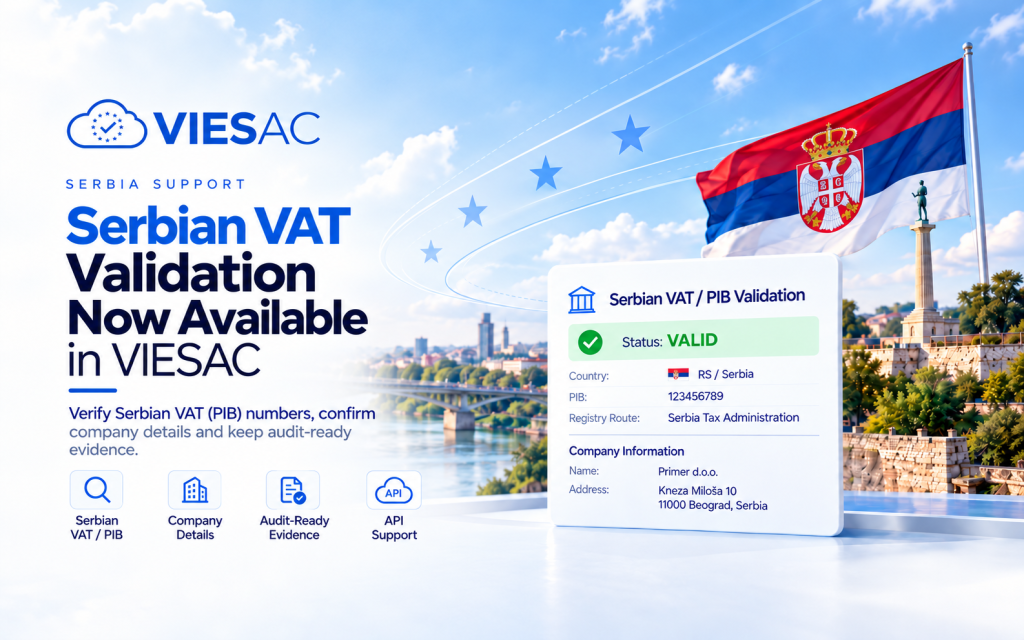
European finance teams, ERP administrators, and cross-border B2B platforms frequently encounter compliance roadblocks when searching for Serbian suppliers or clients in standard EU VIES portals. Because Serbia is outside the EU Single Market, standard EU VAT queries fail with an invalid country code or unsupported jurisdiction error.
Whether you are onboarding Serbian suppliers, reviewing cross-border service invoices for reverse charge eligibility, shipping physical goods across Serbian borders, or complying with Serbia’s mandatory electronic invoicing mandate (SEF / e-faktura), verifying tax standing and retaining immutable audit evidence is essential for protecting your business against tax assessments.
1Serbian Tax Identifiers: PIB (VAT Number) vs. Matični Broj (APR)
One of the most frequent errors in international trade with Serbia is confusing the tax identification number with the business registration number. Serbian authorities distinguish between two core identification codes:
| Identifier | Issuing Authority | Digits & Format | Primary Role in Commerce | Used for VAT & Invoicing? |
|---|---|---|---|---|
| PIB (Poreski Identifikacioni Broj) | Poreska uprava (PURS) | 9 digits (e.g. 100001765 or RS100001765) | Official Tax ID & VAT registration number for tax reporting, invoices & SEF | Yes — Mandatory |
| Matični Broj (MB) | Agencija za privredne registre (APR) | 8 digits (companies) or 8/13 (entrepreneurs) | Company legal registration number in the national commercial register | No (Informational only) |
When issuing invoices, filing foreign trade declarations, or verifying VAT standing, you must always validate the 9-digit PIB. An 8-digit Matični broj cannot be queried in the VAT register and will cause automated invoice validation engines and ERP connectors to reject the transaction.
2Serbian PIB Structure and the ISO 7064 MOD 11, 10 Checksum
The Serbian PIB follows a strict mathematical layout designed to catch human input errors and detect fraudulent numbers before querying the registry. A valid PIB consists of exactly nine numerical digits:

The first eight digits represent the unique numerical serial assigned to the enterprise, institution, or sole trader upon tax registration.

The ninth digit is an algorithmic check digit calculated using ISO 7064 MOD 11, 10 with designated polynomial weights [10, 9, 8, 7, 6, 5, 4, 3].

In cross-border B2B trade, EDI feeds, and ERP systems (SAP, Oracle, Odoo), the ISO 3166-1 alpha-2 prefix "RS" is prepended to form an 11-character string (e.g., RS100001765).
VIESAC performs this mathematical checksum validation in real time before dispatching queries to the national registry, eliminating latency from malformed requests and preventing invalid data entries in your master vendor file.
3PIB vs. PDV: Is Every Serbian Business Registered for VAT?
No. Having an active PIB proves that a company or sole trader is legally registered with the Serbian tax authorities, but it does NOT mean the entity is registered for VAT (PDV — Porez na dodatu vrednost). In Serbia, businesses fall into distinct tax tiers based on annual turnover:
- →Mandatory PDV Registration: Entities with annual taxable turnover exceeding 8,000,000 RSD (approximately €68,000) within the previous 12 months must register in the official Registar obveznika PDV.
- →Voluntary PDV Registration: Businesses below the statutory threshold may opt into the PDV system voluntarily, committing to a minimum statutory period (typically 2 calendar years).
- →Small Businesses & Flat-Rate Taxpayers (Paušalci): Businesses with turnover under 8,000,000 RSD that do not register voluntarily remain outside the PDV system. They possess a valid 9-digit PIB for income tax purposes, but cannot charge PDV or issue tax invoices with deductible input VAT.
When receiving an invoice from a Serbian supplier, foreign accountants must confirm that the supplier is an active PDV payer in the official register. If the supplier is not in the PDV register, any VAT charged is unauthorized and non-deductible under international accounting standards.
| Question | Answer |
|---|---|
| Is Serbia part of the EU VIES system? | No. Serbia is outside EU VIES. Lookups must use the official PURS register. |
| Can a company with a valid PIB be non-VAT registered? | Yes. Entities below 8,000,000 RSD turnover often operate outside the PDV system. |
| What official data is returned upon validation? | Company legal name, registered address, active PDV status, and PIB confirmation. |
4Mandatory Electronic Invoicing in Serbia: The SEF (e-Faktura) Mandate
Serbia is at the forefront of European digital tax reporting, having introduced a comprehensive electronic invoicing mandate under the Law on Electronic Invoicing (Zakon o elektronskom fakturisanju). All B2G (Business-to-Government) and B2B (Business-to-Business) transactions between registered entities must pass through the state-operated Sistem Elektronskih Faktura (SEF).
For international corporations and regional suppliers doing business in Serbia, accurate master data is paramount. Invoices submitted with invalid, unregistered, or suspended PIB numbers are automatically rejected by SEF, leading to blocked commercial payments, customs clearance hold-ups, and statutory late-filing fines.
Under the Serbian Law on Electronic Invoicing, any tax invoice containing an invalid or unverified PIB is immediately rejected at the government API gateway. Validating partner PIBs prior to batch upload completely eliminates rejection loops and manual administrative reconciliation.
By verifying Serbian partner PIBs via VIESAC prior to invoice issuance, ERP workflows ensure that electronic invoice payloads match the authoritative state register, preventing transmission failures in SEF.
5Serbian VAT Rates and Cross-Border B2B Rules in 2026
Serbia enforces a modern VAT framework governed by the Serbian VAT Law (Zakon o porezu na dodatu vrednost). The applicable rates in 2026 include:
- →Standard Rate (20%): Applies to the majority of goods and services supplied in the Republic of Serbia or imported from abroad.
- →Reduced Rate (10%): Applies to basic food supplies, daily newspapers, books, pharmaceuticals, hotel and accommodation services, municipal utility services, and natural gas supplies.
- →Zero Rate with Right of Deduction (0%): Exportation of goods from Serbia to foreign destinations, international passenger and freight transport, and supplies directly linked to free customs zones.
- →Cross-Border Reverse Charge: Under the general B2B place of supply rules, cross-border services provided between EU companies and Serbian entities are generally taxed where the recipient is established. For EU tax authorities to accept zero-rating or non-taxability, the EU supplier must retain proof of the customer’s taxable status (a validated Serbian PIB record).
Tax auditors across Germany (Finanzamt), Austria (Finanzamt Österreich), France (DGFIP), and other EU member states scrutinize cross-border transactions involving third countries like Serbia. Possessing an official timestamped validation certificate protects against retrospective VAT assessments.
6Method 1: Instant Web Verification with the Free Serbian VAT Validator
For finance teams, accountants, and procurement officers handling individual supplier onboarding or single invoice approvals, VIESAC offers a free web validation tool:
- Navigate to the Serbia PIB / VAT Validator.
- Enter the 9-digit PIB, either with or without the country code prefix (e.g. RS100001765 or 100001765).
- Execute the verification to instantly view the official company name (Naziv), registered address (Adresa), and active PDV registration status.
- Log into your VIESAC account to convert the verification into a permanent, audit-ready compliance record.
The tool automatically cleans whitespace, hyphens, and non-numeric artifacts, resolving the target record directly from the official tax authority.
7Method 2: Enterprise REST API for ERP & Platform Automation
Enterprises processing high transaction volumes or running ERP systems (such as SAP, Microsoft Dynamics 365, Oracle NetSuite, Odoo, or Salesforce) cannot rely on manual web checks. The VIESAC VAT Validation API provides a single, unified interface for EU VIES, UK HMRC, Swiss UID, Norwegian MVA, and Serbian PURS registries.
Simply pass RS as the country code with the 9-digit PIB:
POST /api/v1/audits
{
  "country_code": "RS",
  "vat_number": "100001765",
  "invoice_number": "INV-2026-RS-8801"
}The API responds in milliseconds, returns normalized fields, and immediately issues a cryptographically verified audit certificate. For storefronts, see our WooCommerce extension; for custom integrations, see our Make connector and flexible plan pricing.
8Audit-Ready Compliance: Timestamped Certificates and XML Proof
A simple screen confirmation does not satisfy European tax auditors during retrospective tax inspections. Under strict bookkeeping standards (such as GoBD in Germany or statutory audit protocols across the EU), businesses must preserve unalterable proof of supplier tax standing at the date of the transaction.
- →Official PDF Verification Certificate: Complete with QR code verification, timestamp, unique audit identifier, official PURS source confirmation, and registered legal name and address.
- →Cryptographic Raw XML/JSON Evidence: Storing the raw technical payload returned by the Serbian Tax Administration, establishing that the data originated from the governmental authority.
- →10+ Year Secure Cloud Vault: Searchable by invoice number, partner name, or PIB, instantly retrievable during external fiscal audits without sifting through disorganized spreadsheets or local folders.
This end-to-end evidence trail eliminates retrospective tax liabilities, protects zero-rated export declarations, and satisfies auditor scrutiny across all EU member states.
9Common Mistakes When Checking Serbian VAT Numbers
- →Querying the EU VIES Database: Serbia is not an EU member; submitting Serbian numbers to VIES will consistently yield an error or "member state not found".
- →Entering the 8-Digit Registration Number (Matični Broj): Foreign teams frequently attempt to validate the APR company number (MB) instead of the 9-digit tax ID (PIB).
- →Assuming Valid PIB Equals Active VAT Status: Every legal entity has a PIB, but small businesses and flat-rate taxpayers (paušalci) are not in the PDV register.
- →Ignoring the ISO 7064 Checksum: Typographical errors in digits 1–8 result in invalid check digits; validating the checksum locally prevents erroneous vendor records.
- →Relying on Fleeting Browser Screenshots: Screenshots lack cryptographic timestamping, source hash verification, and long-term searchability required by tax authorities.
Avoiding these pitfalls ensures your procurement, legal, and accounting operations remain compliant and audit-proof when trading with Serbia.
10Serbian VAT & PIB Validation FAQ
What does a Serbian VAT number look like?
A Serbian VAT number is based on the 9-digit Tax Identification Number (PIB — Poreski Identifikacioni Broj). Internationally, it is written with the country prefix as RS100001765 or simply as 9 numeric digits 100001765.
Can I check a Serbian VAT number in the EU VIES system?
No. Serbia is not a member of the European Union, and its tax records are not accessible in the EU VIES portal. Serbian VAT registrations must be validated through the official registry of the Serbian Tax Administration (Poreska uprava — PURS) or via VIESAC.
What is the difference between a Serbian PIB and Matični broj (MB)?
The PIB (9 digits) is the tax identification number issued by Poreska uprava (PURS) used for all VAT and tax filings. The Matični broj (8 digits) is the corporate registration number issued by the Business Registers Agency (APR). Only the PIB is used for VAT validation.
Does a valid PIB mean the company is registered for VAT (PDV)?
Not necessarily. All Serbian businesses possess a PIB, but only entities with annual turnover exceeding 8,000,000 RSD (or those who registered voluntarily) are entered into the Registar obveznika PDV. A complete lookup must confirm active PDV payer status.
What is SEF and why does it require PIB validation?
SEF (Sistem Elektronskih Faktura) is Serbia’s mandatory electronic invoicing platform. Invoices sent between businesses or to public bodies are routed through SEF. Inaccurate or unregistered PIB numbers result in immediate invoice rejection by the state portal.
What are the Serbian VAT rates in 2026?
The standard VAT rate in Serbia is 20%, and the reduced rate is 10% (for basic foodstuffs, pharmaceuticals, books, accommodation, and utility services). Exports of goods and qualifying international transport are zero-rated (0%) with the right to deduct input tax.
11Official Sources for Serbian VAT & Tax Verification
All Serbian VAT and company validations performed by VIESAC reference the authoritative governmental databases in the Republic of Serbia:
- →Poreska uprava Republike Srbije (PURS): Official website and regulatory portals at purs.gov.rs.
- →PURS Registar obveznika PDV: Official public register for legal entities and entrepreneurs subject to VAT at purs.gov.rs/pravna-lica/pdv/registar.html.
- →Agencija za privredne registre (APR): National registry of corporate entities, financial statements and Matični broj data at apr.gov.rs.
- →Sistem Elektronskih Faktura (SEF): Government portal for mandatory electronic invoicing under the Ministry of Finance at efaktura.mfin.gov.rs.
Together, these official bodies regulate corporate registration, VAT compliance, and electronic invoicing across the Republic of Serbia. VIESAC connects directly to these authoritative sources to provide automated verification and immutable evidence.
Verify Serbian VAT & PIB Numbers in Real Time
Check Serbian company Tax IDs and active PDV registration against official PURS records, obtain audit-ready PDF certificates, and automate validation via our enterprise REST API.

SEO & Technical Keyword Map
Core queries: Serbia VAT number validation, verify Serbian PIB, check Serbian VAT number, PIB validator Serbia, Poreski Identifikacioni Broj check, PURS PDV register, Poreska uprava Republike Srbije, Registar obveznika PDV, Serbian tax ID lookup. Long-tail & trade keywords: Is Serbia in VIES, PIB vs Maticni broj APR, ISO 7064 MOD 11 10 Serbia, Serbian e-faktura SEF validation, Serbian VAT rates 2026, Serbia reverse charge documentation, RS VAT API.