For years, the PDF has been the gold standard for digital billing. It looks like paper, it's easy to email, and everyone can open it. However, in the eyes of EU tax authorities and the upcoming VAT in the Digital Age (ViDA) initiative, the humble PDF is becoming a relic of the past.
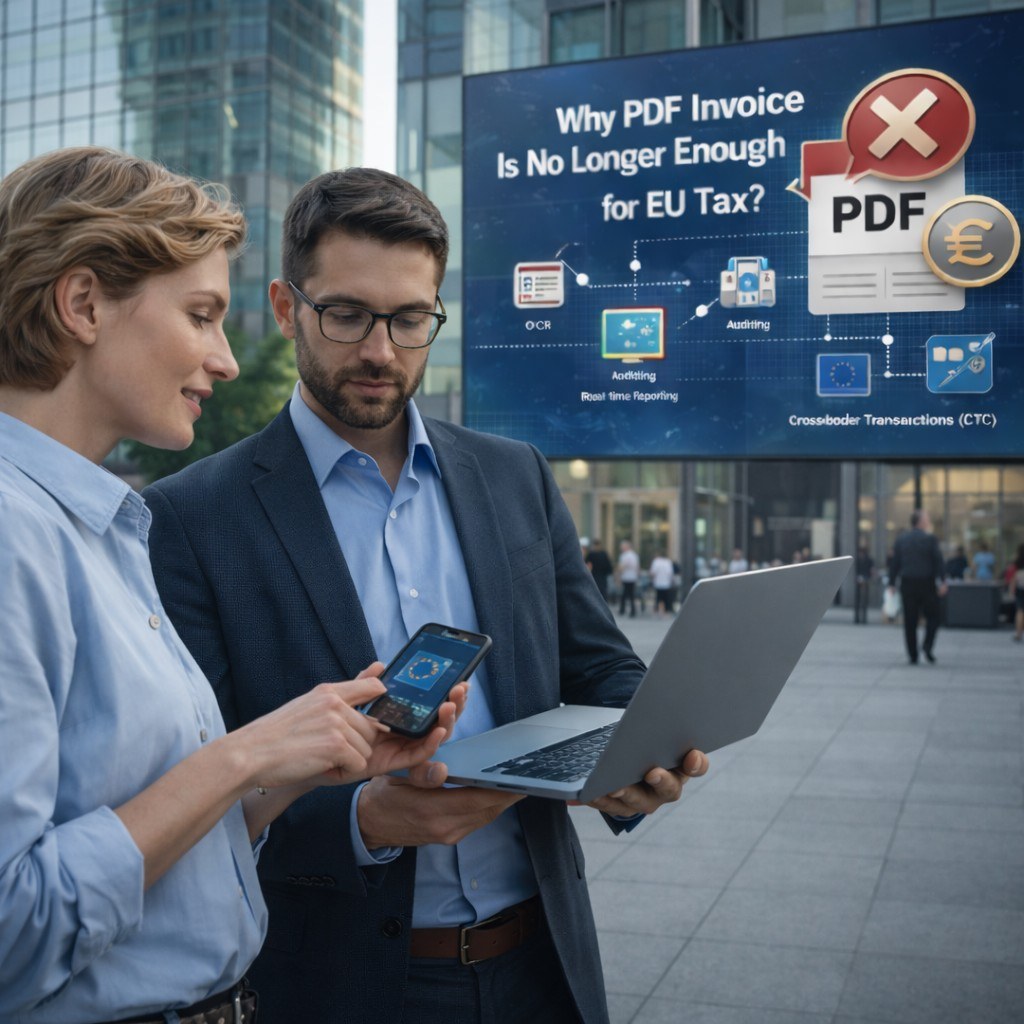
If your business still relies solely on PDFs for cross-border B2B transactions, you are approaching a compliance cliff. Here is why structured data and real-time validation are taking over.
1 The Death of "Unstructured" Data
A PDF is what experts call "unstructured data." While a human can read it, a computer cannot easily "understand" the fields without complex processing.
Under ViDA, the EU is moving toward Mandatory E-Invoicing using structured formats like XML or UBL (Universal Business Language).

Machines at the tax office should be able to read your invoice data instantly.

A PDF is just a digital picture. It doesn't allow for the "near real-time reporting" that the EU now demands.
2 The Missing Link: Proof of Validation
A PDF invoice shows what you sold and who you sold it to. It does not prove that the customer's VAT number was valid at the exact moment of the sale.
Tax authorities now require a clear Audit Trail:
- Validation Evidence: You must prove you checked the customer's VAT status via VIES.
- Time-Stamping: You need to show that the check happened before or at the time of the transaction.
- Storage: A visual "check mark" on a PDF isn't enough. You need the technical response or a VIES Certificate stored in your records.
3 From Visual Documents to Audit Trails
The shift is moving from "keeping copies of invoices" to "maintaining a digital ecosystem." To stay compliant, your business processes must link three things:
Purchase data—what was bought, by whom, and when.

The proof of tax-exempt eligibility—stored and time-stamped.
The structured data file (e.g. XML, UBL) that systems can read.
4 Practical Steps for Your Business
- Adopt Structured Formats: Start looking into XML or UBL invoice generation. If you use platforms like WooCommerce, ensure your plugins are ready for European e-invoicing standards.
- Automate VAT Checks: Don't let your team manually check numbers. Use an API to validate VAT at the point of sale.
- Store Certificates, Not Just Results: Ensure your system keeps a permanent record (a "digital receipt") of the VIES response for every transaction. See how to store VIES certificates.

Future-Proof Your Tax Workflow with VIESAC
Transitioning from PDFs to full compliance can be complex, but VIESAC makes the most difficult part—VAT validation—seamless.
- →Real-Time Validation: Automatically check every EU VAT number via our robust API.
- →Permanent Audit Trail: We don't just tell you if a number is valid; we store the official VIES certificate for you. If an auditor knocks on your door in three years, you'll have the proof ready in seconds.
- →Easy Integration: Whether you are a developer using our API or a store owner using our WooCommerce plugin, VIESAC fits right into your existing stack.
Stop sending just an invoice — Build a compliant audit trail

Pro Tip
Is a PDF invoice legal for ViDA? For proof of supply, yes—but for EU mandatory e-invoicing and VAT validation proof, you need structured data and a stored VIES audit trail. VIESAC validates VAT and stores certificates; integrate via API or use our WooCommerce plugin.