Validating a customer's VAT number for an audit means more than a quick one-off check. Under Article 138 of the EU VAT Directive (2006/112/EC), applying a 0% VAT rate on intra-community B2B supplies is strictly conditional on proving the customer's active taxable status at the precise time of supply. Without a verifiable consultation number and time-stamped proof, national tax authorities (such as the German/Austrian Finanzamt, Dutch Belastingdienst, Polish Urząd Skarbowy, French DGFiP, Spanish AEAT, or Italian Agenzia delle Entrate) can retroactively revoke your zero-rating, forcing your business to pay the full VAT out of pocket plus penalties.
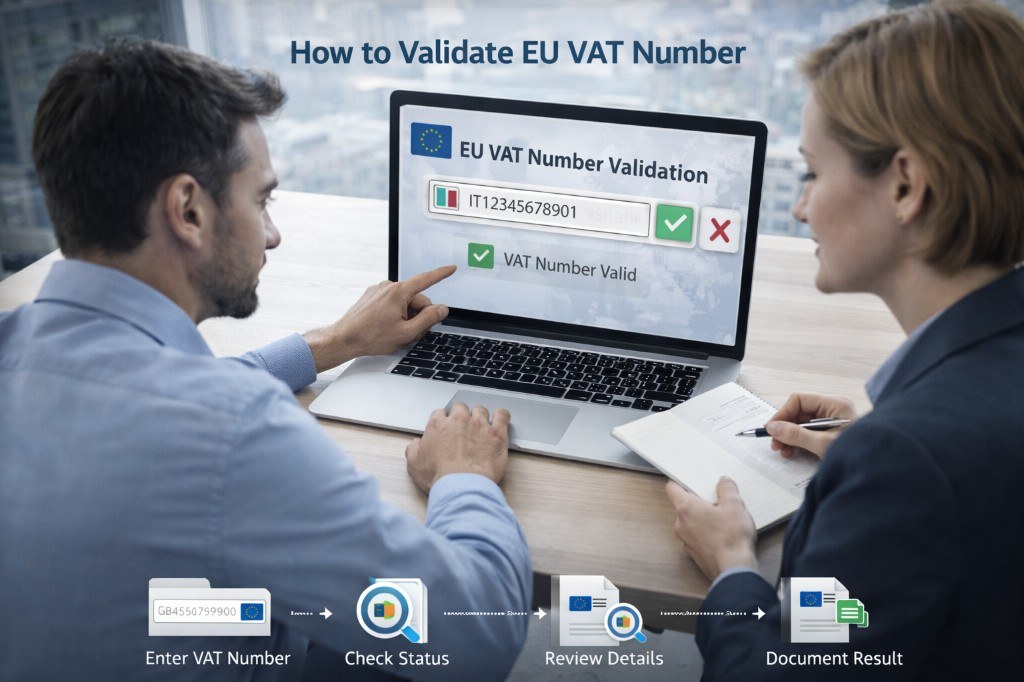
1 Timing: When to Validate
The most common mistake is validating only once during customer onboarding. Under Article 138 due diligence and upcoming ViDA reporting rules, VAT status is dynamic.

Catch invalid or expired numbers before the order is processed. This prevents the administrative nightmare of correcting a zero-rated invoice after it has been issued.

If there is a delay between the order and the invoice, a final check ensures the VAT number is still active at the time the tax point occurs.

For long-term B2B partners, status changes (e.g. business closure or de-registration) can happen at any time. Monthly or quarterly re-validations are recommended best practices.
2 The Anatomy of an Audit-Proof Record
In a tax audit, a simple "Yes, I checked it" or an unauthenticated screenshot is legally insufficient. Under Article 138 EU VAT Directive and domestic statutory rules (such as § 6a UStG / § 17a-c UStDV in Germany), tax inspectors require an indisputable Digital Audit Trail that includes:
| Data Point | Why It Matters |
|---|---|
| VIES Consultation Number | A unique ID provided by the official EU system that proves a specific check took place. |
| The Full Response | Store the name and address associated with the VAT number to prove "qualified" validation. |
| Precise Timestamp | Proof that the check occurred on or before the transaction date. |
| Linking | The validation record must be explicitly tied to your internal order ID or invoice number. |
Read how to store VIES certificates for compliance for the full checklist.
3 Handling VIES Limitations
The official VIES (VAT Information Exchange System) is a gateway to 27 Member State databases (plus Northern Ireland XI and VIES-on-the-Web jurisdictions). It frequently suffers from "Service Unavailable" (MS_UNAVAILABLE) or timeout errors when a national gateway goes offline—for example, Germany’s BZSt eVatR or other national servers.
| Do This | Why It Matters |
|---|---|
| Use SmartRouter™ national fallbacks | VIESAC routes eligible checks via 25+ national tax registry fallbacks across 53 live jurisdictions (see full coverage across 116 countries) when a VIES Member State gateway fails. |
| Document the downtime | Having an eIDAS RFC 3161 timestamped record that VIES was unreachable—plus automated retry logs—provides statutory due diligence (e.g. Vertrauensschutz before the Finanzamt, Belastingdienst, etc.) if an audit occurs later. |
See what to do when VIES is unavailable for a full strategy.
4 Frequently Asked Questions: Audit-Grade VAT Validation
What makes an EU VAT validation check "audit-proof" under Article 138?
An audit-proof record includes the official VIES consultation number or national registry response, matched legal name and address, timestamp at or before supply, and linkage to your invoice or order ID.
Is a browser screenshot from the EU VIES website accepted by tax authorities?
Rarely. Unauthenticated screenshots lack cryptographic integrity. VIESAC generates PDF certificates and raw XML/JSON sealed with SHA-256 hashing and an eIDAS-qualified RFC 3161 timestamp from DigiCert EU, independently verifiable at viesac.eu/verify.
What should we do if VIES returns MS_UNAVAILABLE or TIMEOUT?
Do not guess or block legitimate B2B checkouts blindly. VIESAC’s SmartRouter™ falls back to 25+ national tax registries (view 53 live jurisdictions) and logs timestamped retry records to support Vertrauensschutz.
How often should recurring B2B customers be re-validated?
Best practice is validating at onboarding, again at invoice/checkout, and on a recurring schedule (daily, weekly, monthly, or quarterly) via automated monitoring or Bulk Audit CSV/XLSX.
Can VIESAC validate non-EU VAT numbers and customs IDs in the same audit log?
Yes. VIESAC covers 53 live jurisdictions across 116 countries—including EU, UK, Norway, Switzerland, Serbia, Turkey, and more—alongside EU/UK EORI, REX, SEED, and SME identifiers via REST API, WooCommerce, Shopify, SAP, Microsoft, Google Sheets, Make, and AI MCP.

Automate Your Compliance with VIESAC
Managing manual checks and storing PDF certificates for 8–10+ years is an impossible task for a modern business. VIESAC automates the entire lifecycle of VAT, EORI, REX, SEED, and SME validation.
- →Real-time API & ERP Validation: Connect via REST API, Bulk Audit CSV/XLSX, SAP, Microsoft, Google Sheets, Make, or AI MCP across 53 live jurisdictions / 116 countries.
- →Tamper-Evident Certificate Storage: PDF certificate + XML/JSON response with SHA-256 & eIDAS RFC 3161 DigiCert EU timestamp, verifiable at viesac.eu/verify.
- →SmartRouter™ Resilience: 25+ national registry fallbacks plus automatic retry logic during VIES interruptions.
- →WooCommerce & Shopify: Instantly add audit-ready VAT validation to your B2B checkout without writing custom validation code.
Don't leave compliance to chance — Build your audit trail today

Pro Tip
ViDA and Article 138 VAT validation requirements include a VIES consultation number (or national registry reference) and proof of zero-rated B2B sale. Use a VIES API with RFC 3161 certificate storage or our WooCommerce / Shopify integrations for an automatic audit trail verifiable at viesac.eu/verify.