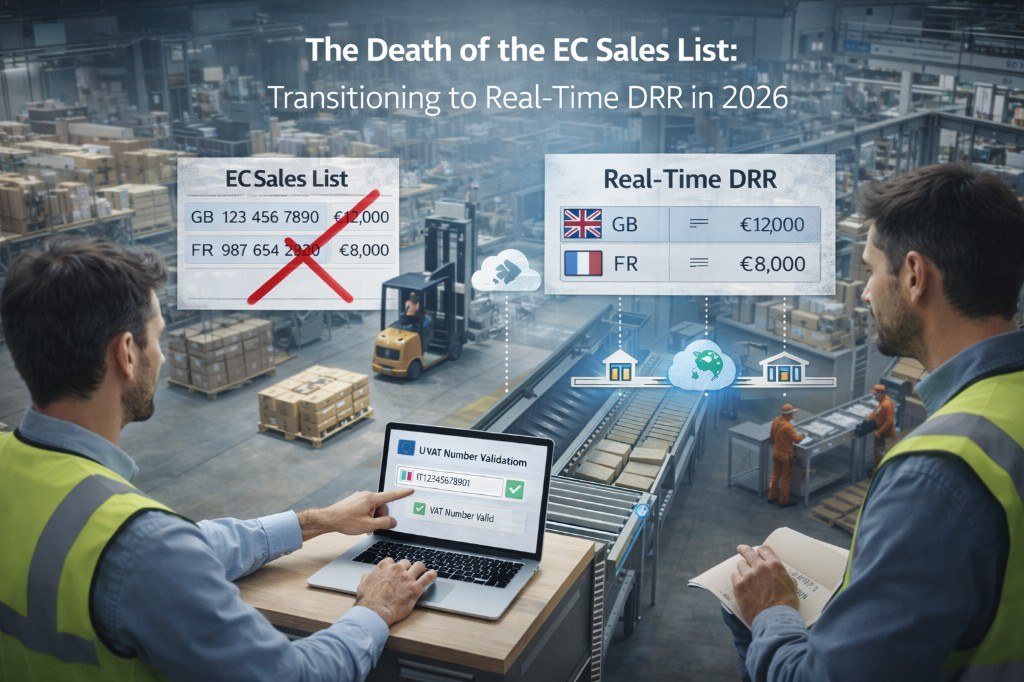
For decades, EU businesses have relied on the EC Sales List (Recapitulative Statement) to report cross-border B2B sales. It was a slow, periodic process—usually done once a month or once a quarter. But as of 2026, that era is officially coming to an end.
Under the VAT in the Digital Age (ViDA) initiative, the EU is replacing these old summaries with Digital Reporting Requirements (DRR). The shift is simple but brutal: VAT reporting is moving from periodic to near real-time.
1 Why the EC Sales List is Becoming Obsolete
The old system had a major flaw: a "reporting gap." By the time a business reported a sale at the end of the month, the transaction was weeks old, making it easy for "carousel fraud" to drain billions from EU budgets.
In 2026, the rules have changed:
| What Changed | Why It Matters |
|---|---|
| Transaction-by-Transaction | You no longer report a summary of sales to a client; you report every single invoice individually. |
| The "Near Real-Time" Window | Data must be transmitted to tax authorities almost immediately (often within 2 to 10 days of the transaction). |
| Two-Way Matching | Tax authorities now cross-check the supplier's data against the buyer's data in real-time. If they don't match, an audit is triggered automatically. |
2 The New Risk: No More "Fixing it Later"
In the past, accountants could catch a typo or an expired VAT number during the end-of-month reconciliation. With DRR, if you issue an invoice with an invalid VAT number today, the tax authorities will know it's wrong by tomorrow.
Failure to adapt leads to:
| Risk | Why It Matters |
|---|---|
| Instant Compliance Red Flags | Automated systems will flag your business for inconsistency. |
| Loss of VAT Exemption | If you cannot prove a valid VAT status at the moment of the real-time report, you may be forced to pay the VAT yourself. |
| Operational Bottlenecks | Manual reporting cannot keep up with the 2-day or 10-day windows required by modern EU mandates (e.g. Belgium, Poland, France). |
3 How to Stay Ahead of the DRR Revolution
To survive in a real-time reporting environment, your VAT validation must be as fast as your sales.
| Do This | Why It Matters |
|---|---|
| Automate or Fail | Manual VIES checks are the "weakest link." You need a system that validates VAT numbers at the point of checkout or invoice creation. |
| Audit-Ready Certificates | Because reporting is instant, your "proof of due diligence" must be generated instantly. You need a time-stamped certificate for every transaction. |
| Centralize Your Data | Use a platform that links your e-invoices, your VIES validation proof, and your tax reporting into one digital thread. |

Why VIESAC is the Essential Tool for 2026
VIESAC was built for the speed of the DRR era. We help you bridge the gap between your sales platform and EU compliance.
- →Lightning-Fast API: Validate VAT numbers in milliseconds within your ERP or webshop.
- →The DRR Audit Trail: We automatically store the official VIES response and generate a downloadable PDF certificate for every check, keeping you safe for 10+ years.
- →Smart Queuing: If VIES is down, we don't just give up. We queue and retry the check automatically, ensuring your real-time reporting data is accurate as soon as the servers are back online.
The clock is ticking on periodic reporting — Is your business ready?

Pro Tip
ViDA Digital Reporting Requirements 2026 mean transaction-level reporting and the end of the EC Sales List as you know it. Use a VIES API for real-time DRR compliance and WooCommerce to keep your VAT exemption proof and audit trail in sync. VIESAC stores every check with a certificate—ready for 2026.